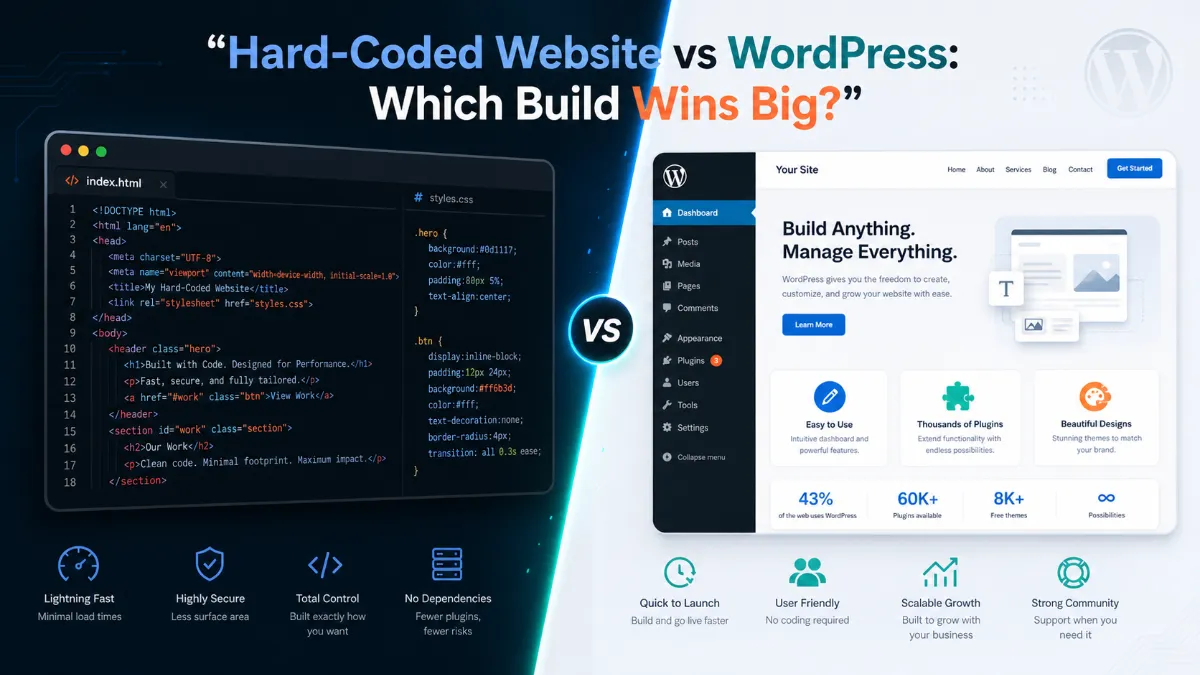
If you’re staring at a blank screen wondering whether to pour your energy into a hand-built site or spin up something in WordPress, you’re not alone—and the “hard-coded website vs WordPress” decision is bigger than it looks at first glance. The platform you choose will shape how fast you launch, how easily you rank, how much you spend, and how painful—or fun—it feels to grow your digital presence over the next few years.
In this guide, we’ll walk you through the real-world tradeoffs so you can confidently choose the option that actually matches your goals, not just what sounds cool in a dev forum.
Why this decision matters more than you think
Before you even compare a hard-coded website vs WordPress, it helps to understand what you’re really choosing: speed vs flexibility, control vs convenience, and upfront cost vs long-term agility. You’re not just picking a tech stack—you’re choosing how fast you can ship ideas, respond to market changes, and keep your marketing team from wanting to throw their laptops out the window.
A custom-coded site can feel like commissioning an architect to build a one-of-a-kind home: everything is tailored, nothing is wasted, and the performance can be razor sharp. WordPress, on the other hand, is like moving into a beautifully designed, highly customizable condo tower: the structure already exists, but you can still make it very much your own, and maintenance is a lot easier.
Once you frame the “hard-coded site vs WordPress” question this way, the right choice starts to come into focus.
What is a hard-coded website, really?
A hard-coded website is built from the ground up using languages like HTML, CSS, JavaScript, and often a backend language such as PHP, Node.js, or Python. Instead of relying on a content management system, your developer writes the structure, layout, and functionality directly into the codebase.
This approach gives you near-total control over everything: performance, design, security, and database logic. In the hard-coded and WordPress sites conversation, the custom route is usually favored when businesses have complex requirements or need something truly unique that can’t be easily replicated with themes and plugins.
Core advantages of hard-coded sites
When you stack the two options, several strengths stand out on the custom side:
For high-traffic platforms, custom SaaS products, or specialized web apps, a hard-coded approach often wins the “hard-coded site vs WordPress” debate because WordPress simply wasn’t built for that level of bespoke functionality out of the box.
Real-world drawbacks of going fully custom
Of course, that power comes at a price. When you line up a hard-coded site from the perspective of cost and day-to-day usability, custom builds can be a heavy lift.
So when you think about choosing between a hard-coded website and a WordPress site, ask yourself: am I prepared for that ongoing dependency on developers, or do I want my marketing team to move fast without filing tickets for every single text change?
What makes WordPress so dominant?
WordPress is an open-source content management system that powers a massive percentage of sites on the internet and is especially popular with marketers, bloggers, and small to mid-sized businesses. You install WordPress on a server, choose a theme, add plugins for extra functionality, and manage your content through an admin dashboard instead of working directly in code.
When comparing a hard-coded website and WordPress, the WordPress side often wins for ease of use and speed of deployment. You can go from idea to live site in days instead of weeks or months, particularly if you’re working with an experienced implementer who knows which themes and plugins to trust.
WordPress strengths that matter to high-intent businesses
From a growth-focused perspective, a “hard-coded website vs WordPress” showdown tends to favor WordPress for a lot of small and medium businesses.
If your priority is speed to market, agility, and empowering your marketing team, WordPress gives you a huge head start.
Limitations and tradeoffs of WordPress
WordPress isn’t magic—it’s a tool with boundaries. When you look at a hard-coded website vs a WordPress site from a purely technical perspective, WordPress does introduce some constraints.
For many businesses, these are manageable tradeoffs—and still preferable when weighing the two options, especially if there isn’t a dedicated dev team on staff.
Performance and scalability: speed, traffic, and future-proofing
Let’s talk about speed and scale, because they sit at the heart of any serious “hard-coded site vs WordPress” comparison. Search engines, users, and AI crawlers all favor fast, stable, secure sites.
Performance potential of hard-coded builds
In a vacuum, a well-built hard-coded site is usually going to be lighter and faster than a comparable WordPress site, because it contains only what your developer intentionally includes. There’s no unused theme code, no dormant features, and no plugin bloat.
This gives you more predictable performance at high traffic levels and can make it easier to fine-tune everything from caching strategies to database queries. In the debate, that level of control is a key reason large-scale, heavily customized apps and platforms lean toward custom development.
Performance reality of WordPress
Out of the box, WordPress may not always win a raw performance contest, but with a good theme, optimized hosting, caching, and selective plugins, it can absolutely be fast enough for competitive SEO and strong user experience. Many high-traffic publishers and brands use WordPress successfully at scale.
So if you’re comparing a hard-coded website vs WordPress for a typical business site, the performance gap is often narrower than people assume—provided the WordPress implementation is handled thoughtfully. It’s less about the platform and more about execution.
Scalability and complexity
Scalability is where the decision becomes very situational. If you’re building a complex application with custom logic, multi-tenant functionality, or specialized data flows, custom-coded architecture is typically a better long-term play.
But if your growth path looks more like “we want to publish more content, add landing pages, maybe launch a course or an online store,” WordPress scales quite comfortably with the right stack and infrastructure. In many cases, trying to solve that with a fully hard-coded approach is overkill and slows the team down.
SEO and AI search: how each option really performs
When you pit a hard-coded website vs WordPress purely on SEO potential, the honest answer is that both can rank extremely well when implemented properly. Search engines don’t inherently prefer one over the other; they care about content quality, structure, performance, and crawlability.
SEO with hard-coded sites
With a hard-coded site, you or your developer control every detail: URL structures, meta tags, schema markup, internal linking logic, site speed, and more. That can be an advantage if you have strong SEO expertise and direct access to your codebase.
However, everything is manual. You’ll need processes and tooling for XML sitemaps, schema implementation, redirects, and on-page optimization. When doing a hard-coded and Wordpress website comparison, the custom route rewards technical SEO skills but punishes teams that can’t execute consistently.
SEO with WordPress
WordPress offers a naturally SEO-friendly structure and, more importantly, a rich ecosystem of plugins like Yoast SEO and Rank Math. These tools make it easier for non-technical users to manage meta tags, sitemaps, redirects, and basic on-page optimization from within the dashboard.
This convenience is a major win when you’re comparing a hard-coded website to a WordPress build for marketing-led teams. It removes friction, which leads to more consistent optimization over time—something search engines reward more than any specific CMS feature.
AI search and answer engines
As AI-driven search experiences evolve, platforms increasingly look for: clear information hierarchy, structured data, consistent topical coverage, and clean, machine-readable markup. Both a hard-coded website and a WordPress site can provide that if you plan for it.
The practical difference is that WordPress makes it easier to roll out schema markup, FAQ sections, and structured content patterns at scale using plugins and block-based layouts. On a hard-coded site, you can implement incredibly precise AI-optimized structures—but it requires development time every time you want to experiment.
If being nimble with content and structured data is core to your strategy, that may tilt the “hard-coded website vs WordPress” decision toward WordPress unless you have an embedded dev/SEO team that can push changes quickly.
Cost, timelines, and total cost of ownership
Budget and timing quietly drive most technology decisions, even if no one wants to say it out loud. When you realistically compare the two options from a cost perspective, the differences are stark.
Upfront build costs
If you’re launching a new brand, testing a business idea, or rebuilding a site that needs to go live quickly, the question often comes down to: do you want to spend more on code or more on marketing and content in year one?
Ongoing maintenance and change costs
Custom-coded sites usually come with higher ongoing maintenance and change costs, because you need developer support for most meaningful updates. When you revisit the hard-coded website and WordPress tradeoff six months after launch, this is the part many teams regret underestimating.
WordPress, by contrast, shifts much of the day-to-day ownership to your marketing and content team. You’ll still need some technical oversight for updates, backups, and security—but not for every copy tweak or landing page test. Over time, that agility often outweighs the risks, especially for marketing-heavy businesses.
Control, customization, and brand experience
Some brands care deeply about owning every pixel, animation, and micro-interaction. For those teams, the question is as much about creative control as it is about code.
Where hard-coded sites shine creatively
With a custom build, your design and UX team can imagine something completely unique and have developers bring it to life without fighting against theme limitations or plugin quirks. You can fine-tune the way content flows, how menus behave, how complex calculators function, and how users move through buying journeys.
In a high-end brand context, the hard-coded website vs WordPress decision often leans custom because subtle UX details and performance can directly influence perceived quality and conversion rates.
WordPress and modern customization
That said, modern WordPress ecosystems—with flexible block themes, advanced page builders, and custom fields—are far more capable than they used to be. For many brands, the level of customization available is more than sufficient, especially when a developer lightly extends or customizes a theme.
If you’re comparing a hard-coded website to WordPress and your primary requirement is “professional, on-brand, conversion-optimized design,” WordPress can absolutely deliver, often faster and more affordably. The point where you truly “need” a fully custom build is usually farther out than people assume.
Who should choose a hard-coded website?
Let’s make this practical. In the “hard-coded website vs WordPress” decision, you’re a strong candidate for a custom-coded site if:
If your revenue model depends heavily on the uniqueness and complexity of your online experience—think SaaS platforms, custom portals, specialized booking engines—a comparison often ends with “we need custom.”
Who should choose WordPress?
On the flip side, WordPress tends to be the right move in the “hard-coded website vs WordPress” debate when:
For service businesses, local companies, coaches, agencies, and many e-commerce stores, a well-built WordPress site is more than enough to win in competitive search results and convert high-intent visitors. In these cases, making a choice often just delays launch and eats margin.
Making the decision: a simple mental framework
By now, you’ve seen how nuanced this decision can be. To bring it home, use this mental framework as you decide.
Ask yourself three core questions:
If your honest answers sound like “we’ll be updating content constantly, marketing will drive most changes, and our main goal is to generate leads or sales,” WordPress is almost certainly the smarter choice in the conversation.
If instead you’re building a product, platform, or deeply specialized experience, and you have the technical resources to support it, a custom build will likely serve you better over the long term—even if it demands more up front.
FAQs about Hard-Coded Websites vs WordPress Sites
What is the main difference between a hard-coded website vs WordPress?
The core difference between the builds is how the site is built and managed over time. A hard-coded site is created line by line by developers using programming languages, while WordPress provides a content management system with themes and plugins that let non-developers create and manage content through a dashboard.
Which is better for SEO: a hard-coded website vs WordPress?
From a search engine’s perspective, both a hard-coded website and WordPress can rank extremely well when implemented properly. WordPress has an edge in usability because SEO plugins make it easier for non-technical users to manage meta tags, sitemaps, and structured content, but a well-built custom site can match or exceed that performance if you have strong SEO and development resources.
Is a hard-coded website more secure than a WordPress site?
Security comes down to implementation and maintenance rather than the simple choice of a hard-coded website vs WordPress. A custom site may have fewer third-party components and therefore a smaller attack surface, but WordPress can be highly secure when you use reputable plugins, keep everything updated, and follow best practices for hosting, backups, and access control.
Which option is cheaper long term: a hard-coded website or WordPress?
Over the full life of a site, a hard-coded site usually ends up more expensive because you rely on developers for most updates and new features. WordPress tends to offer a lower total cost of ownership for typical business sites, since your marketing team can handle many changes internally and you can extend functionality with off-the-shelf plugins instead of custom builds.
Which is better for a small business: a hard-coded website or a WordPress?
For most small businesses, the advantages of WordPress win the “hard-coded website vs WordPress” decision. The ability to launch quickly, make frequent content updates, and leverage SEO-focused plugins usually outweighs the potential performance and customization benefits of a fully custom-coded site, especially when budgets and technical resources are limited.
How do I decide between a hard-coded website vs WordPress for a growing brand?
If your growth strategy depends heavily on content, SEO, and rapid experimentation with offers and landing pages, WordPress is typically the better fit in the overall tradeoff. If your growth hinges on delivering a unique, complex product experience with specialized functionality, and you have access to reliable technical talent, investing in a custom-coded site can be the right long-term play.