
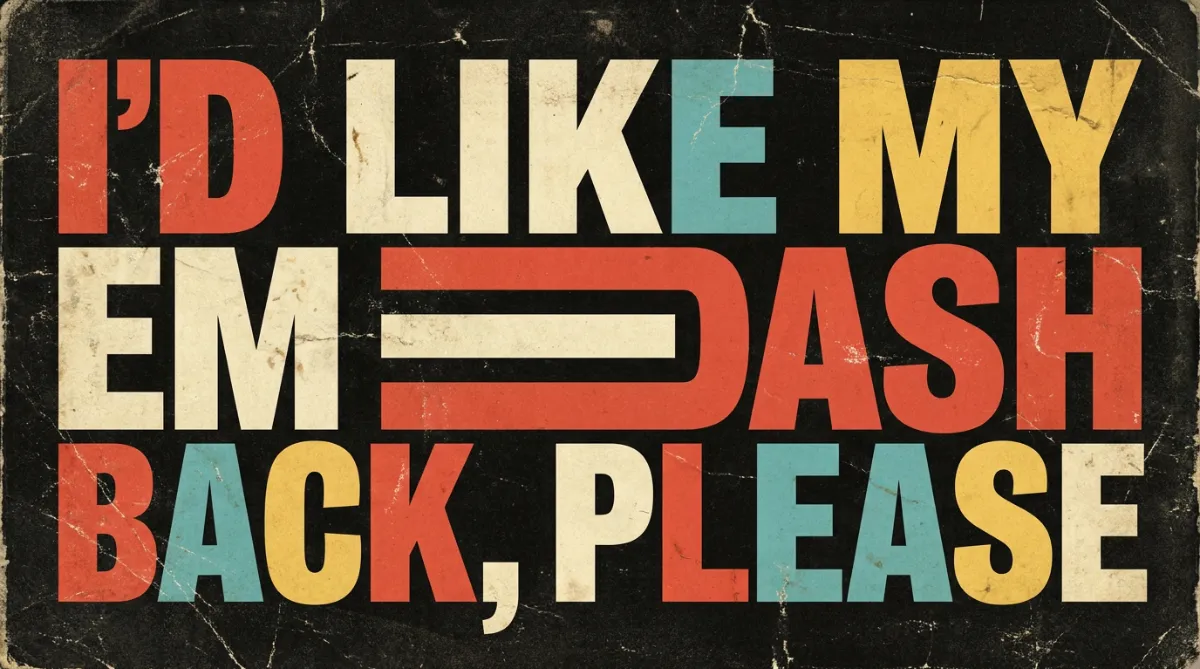
I used to love the em dash.
Not in a precious, grammar-purist way, but in a working writer’s way. It was fast. It was flexible. It let me pivot mid-thought without sounding like I’d just stepped out of a Victorian novel. It was the punctuation equivalent of a guitar bend—expressive, a little dramatic, and occasionally unnecessary but fun anyway.
Then AI showed up and absolutely wrecked it.
Suddenly, the em dash wasn’t just punctuation. It became a tell. A signal. A scarlet letter for “this was probably written by a machine.” And just like that, something I’d used for years without thinking turned into something I hesitated to touch.
Which is ridiculous.
When Punctuation Gets a Reputation
Let’s be honest about what happened. AI models didn’t invent the em dash. Writers, journalists, bloggers, and anyone who’s ever tried to make a sentence feel like a thought instead of a robot log have been using it forever.
“The use of dashes in English writing can be traced back to the 17th century, but the em dash as we know it emerged more formally in the 18th century, thanks to advancements in printing and typesetting. The name “em dash” comes from the traditional width of the dash being equal to the letter “M” in a given font.” - Zul M, PublishingState
But AI adopted it aggressively. Overused it. Flattened it. Yuck.
Instead of sounding like a natural pause or a stylistic flourish, it started to feel formulaic. Predictable. Every paragraph had one. Sometimes two. Occasionally three, like it was being paid per dash or doing it for the sake of eating credits.
And now we’re here, in a strange moment where readers have started associating a legitimate piece of punctuation with synthetic writing.
That’s not the em dash’s fault. That’s like blaming distortion pedals for bad guitarists. Side note: you absolutely can blame distortion pedals for bad guitarists. Just not all of them … especially the Tube Screamer.
The Real Problem Isn’t the Dash
The issue isn’t the punctuation. It’s the pattern!
AI tends to write in rhythms. Once you’ve read enough of it, you start to hear the cadence. It’s polished, balanced, and just slightly too consistent. The em dash became part of that rhythm because it’s an easy way to simulate complexity. It creates the illusion of layered thought without actually doing the work.
That’s why it stands out now. Not because it’s inherently artificial, but because it’s been over-signaled.
So what do humans do? We overcorrect, right?
We strip it out. Replace it with commas. Or periods. Or awkward sentence fragments that don’t quite land the same way. We start second-guessing our own voice because we don’t want to “sound like AI.” Don’t get me started with digital artwork that showcases time, precision, and care (that’ll be another blog at some point).
Which is a weird place to end up as a human who was, in fact, here first.
I Refuse to Give It Up
I’m not giving up the em dash.
Not completely, anyway.
I’ll admit I’ve pulled back. I’m more aware of it now. I use it with intention instead of muscle memory. But abandoning it altogether feels like letting AI redefine what human writing is supposed to look like.
And I’m not interested in that.
Because here’s the thing: good writing has always been about voice. About rhythm. About knowing when to break the rules just enough to sound like a person instead of a textbook. The em dash was part of that toolkit. It still is. We don’t need to retire it. We just need to use it like we actually mean it.
The Difference Between Voice and Pattern
There’s a subtle but important distinction here. AI uses the em dash as a pattern. Humans use it as a choice.
When I drop one into a sentence, it’s because I want that slight (or not so slight) shift in tone. That pause that isn’t quite a comma and isn’t quite a period. It’s a conversational move. A way of saying, “hang on, I’ve got one more thought before we move on.” I like exposing to others how my brain works. And the em dash helps simulate it.
When AI does it, it often feels like it’s following a template. The same structure repeated with different words plugged in.
That’s why readers notice (I think?).
And that’s also why the solution isn’t to eliminate the dash. It’s to bring back intention, ferociously, to our writing!
Yes, I’m Using One Right Now — Relax
There it is.
Did the world end? Did the paragraph suddenly become less human? I guarantee at least one reader paused for a split second and thought, “huh.” Break out the pitchforks! That reaction is the whole point of this piece. The em dash has become loaded. Not because it changed, but because our perception of it did.
Which means, in a way, we’re now writing under a new kind of pressure. Not just to be clear or engaging, but to prove we’re not machines. That’s a strange burden to put on our choice of expression, and it’s ridiculous.
Writing Like a Human Again
If there’s a takeaway here, it’s not “use more em dashes” or “never use them again.” It’s simpler than that.
Write like you. Write with intention. Light a fire!
If your natural voice includes the occasional em dash, keep it. If it doesn’t, don’t force it. The goal isn’t to dodge AI detection heuristics like you’re gaming an algorithm. It’s to sound like a person with a perspective.
Ironically, the more we contort our writing to avoid looking like AI, the more unnatural it becomes. We start editing out the quirks and rhythms that actually make our voice distinct.
That’s the real loss. Not the dash.
Reclaiming the Tools
The em dash is just one example, but it won’t be the last. Don’t you DARE mess with my ellipsis… As AI continues to generate more content, certain phrases, structures, and stylistic choices will get flagged as “AI-ish.” Some of that will be useful. A lot of it will be noise. Most is just trash (or… AI in general, some rightfully call it slop).
We don’t need to surrender every tool that gets caught in that crossfire. In fact, never surrender! We just need to maybe use them better? More deliberately? More sparingly? More like humans who understand why they’re making a choice, not just following a pattern because it “sounds right.” … ???
Hold Your Ground!
The em dash didn’t betray us. It didn’t suddenly become artificial. It just got popular in the worst possible way. So, I’m keeping it in rotation. Not as a crutch, not as a signature move, but as one option of expression among many. We need options, folks, A piece of punctuation that still does exactly what it always did when used well.
And if that means occasionally sounding a little like AI, so be it.
Because I was here first.