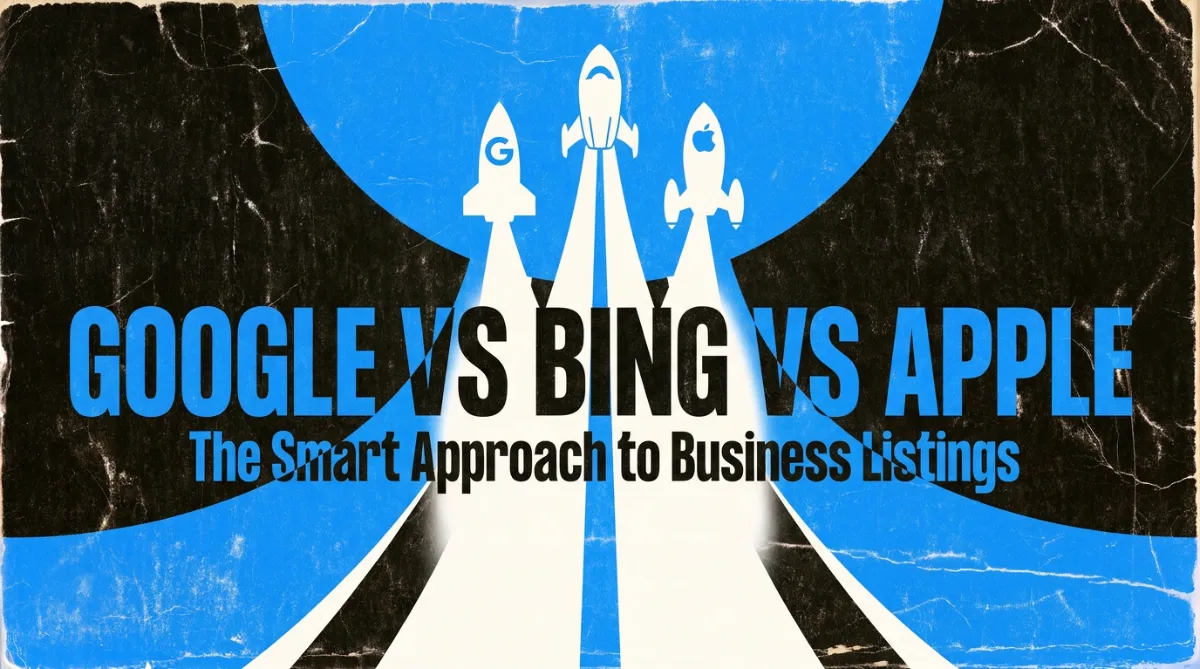
If you are serious about visibility, your business listings need to exist across more than just Google.
For years, Google has dominated local search, and for good reason. It is still the primary driver of discovery, calls, and map-based traffic. But the reality today is that relying on a single platform leaves gaps in your reach, your data control, and your brand consistency. Customers are searching across multiple ecosystems, and your presence needs to match that behavior.
A complete business listings strategy includes Google, Bing, and Apple at a minimum. Each platform serves a different segment of users, and together they create a more resilient and far-reaching local presence. In fact, this stuff is so important we include it as part of our Supercharged SEO/AEO service!
Google Business Profile Still Leads the Pack
Google remains the king of business listings. It owns the largest share of search traffic, dominates mobile discovery, and powers Google Maps, which is often the first touchpoint for local intent.
A well-optimized Google Business Profile drives:
- High visibility in local search results
- Direct calls and direction requests
- Customer reviews that influence buying decisions
- Integration with Google Ads and local campaigns
Google’s ecosystem is unmatched in scale and ignoring it is not an option. However, many businesses stop here, assuming that Google alone is enough. That assumption is where opportunities are lost. Lots of them.
Even though Google leads, it does not capture every search. Not every user is on Android. Not every browser defaults to Google. And not every voice assistant relies on Google data.
That is where expanding your business listings becomes critical.
Bing Business Listings Are More Powerful Than You Think
Bing is often overlooked, but that is a mistake. Microsoft’s search engine powers results across Windows devices, Edge browsers, and integrations with tools like Copilot and Microsoft 365.
One of the biggest advantages of Bing business listings is how easy they are to maintain. Bing can sync directly with your Google Business Profile and automatically pull updates on a weekly basis. That means your hours, photos, and core information stay aligned without constant manual updates.
This creates a low-effort expansion of your visibility.
Bing also reaches a different demographic. It tends to skew toward desktop users, corporate environments, and older audiences with strong purchasing power. If your business serves professionals, B2B clients, or higher-income households, Bing is not optional.
From an operational standpoint, adding Bing to your business listings strategy is one of the highest return, lowest effort moves you can make.
Apple Business Connect Reaches High-Intent Users
Apple Business Connect is the newest major player in business listings, but it is already essential. Apple Maps is the default navigation system for millions of iPhone users. Every time someone asks Siri for a nearby service or searches within Apple Maps, they are pulling from Apple’s business listings database.
Ignoring Apple means missing a massive portion of mobile users.
Apple Business Connect offers several unique advantages:
- Direct control over how your brand appears in Apple Maps
- Integration with Siri voice search
- High visibility among iPhone users who often have strong purchasing intent
- Complimentary custom email addresses tied to your domain when setting up your business presence
That last point is often overlooked. Apple provides an added layer of brand credibility by allowing businesses to use domain-based email integration as part of their ecosystem. It is a subtle but powerful trust signal.
Apple’s ecosystem is tightly controlled, which means accuracy matters even more. If your information is wrong or missing, users have fewer ways to find you compared to Google.
Why One Platform Is Not Enough
Relying on a single platform creates blind spots in your business listings strategy.
Here is what happens when you diversify:
- You increase total search surface area across devices and ecosystems
- You ensure consistency in your business information
- You reduce dependency on a single algorithm or platform change
- You capture users across different demographics and behaviors
Think of it this way. Google captures intent at scale. Bing captures overlooked but valuable segments. Apple captures high-intent mobile users inside a closed ecosystem.
Together, these platforms create a complete local visibility network.
Consistency Is What Drives Results
Having business listings on all three platforms is only part of the equation. The real impact comes from consistency.
Your business name, address, phone number, hours, services, and branding should match across all platforms. Even small discrepancies can affect trust, rankings, and user experience. Photos should also be current and aligned with your brand identity. Reviews should be monitored and responded to. Updates should be pushed regularly.
This is where many businesses struggle. Maintaining business listings across multiple platforms can become time-consuming, especially when managing multiple locations or services. That is why automation and synchronization, like Bing’s weekly Google sync, become so valuable.
The Competitive Advantage of Full Coverage
Most businesses still focus only on Google. That creates an opportunity. By fully optimizing your business listings across Google, Bing, and Apple, you position yourself ahead of competitors who are only partially visible.
This is not just about being found. It is about controlling your brand presence everywhere your customers might look.
When your listings are complete, accurate, and active across all platforms, you build:
- Stronger brand authority
- Greater customer trust
- More consistent lead generation
- Better long-term search resilience
In a competitive local market, these advantages compound over time.
Proxy Marketing & Tech Can Help
If your current strategy only includes Google, you are leaving visibility on the table. Expanding your business listings to include Bing and Apple is no longer optional if you want full market coverage.
The good news is that this is not complicated when done correctly. With the right setup, synchronization, and optimization, you can create a system that maintains itself while continuing to drive results.
If you want help getting your business listings properly set up, optimized, and synchronized across Google, Bing, and Apple, Proxy Marketing & Tech can handle the entire process for you. From initial setup to ongoing management and optimization, we make sure your business shows up everywhere it should, accurately and consistently. Reach out to get your listings working as a true growth channel instead of just a placeholder.