
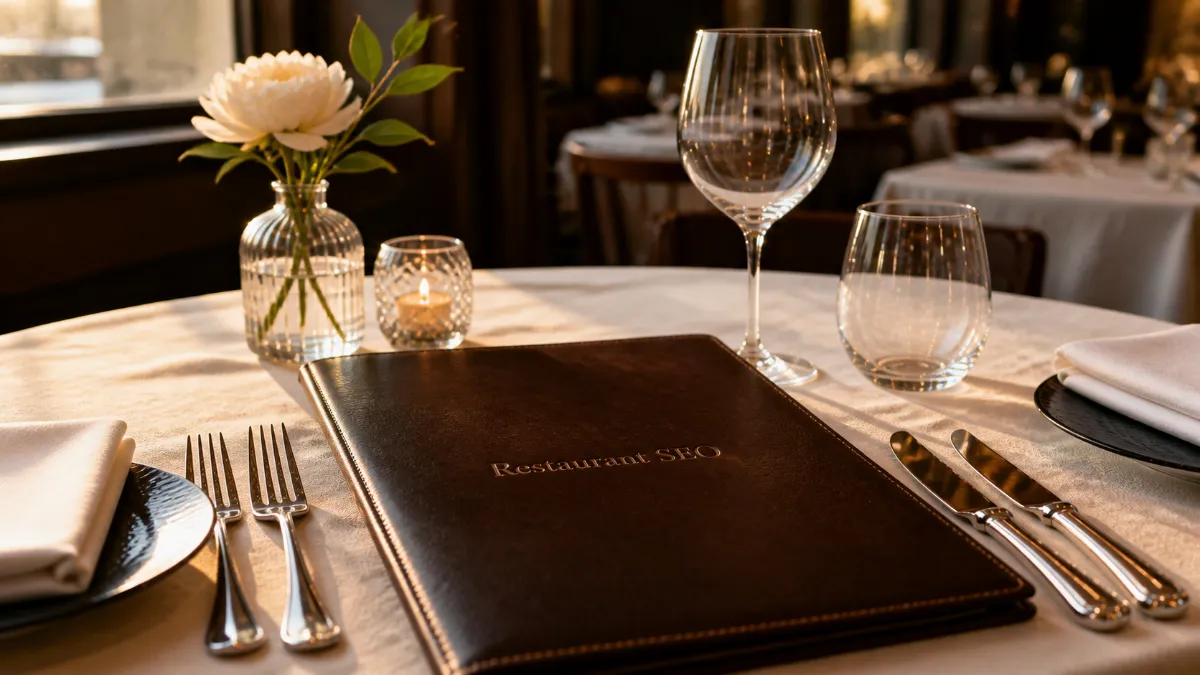
The restaurant industry lives and dies by visibility and trust, and a focused approach to restaurant SEO is one of the highest‑ROI levers to drive both—especially in a world where hungry guests decide with a quick search on their phones. By treating SEO as a core growth channel rather than a side project, restaurants can consistently fill more tables, increase online orders, and build a durable local brand advantage.
Why restaurant visibility now decides revenue
When diners are choosing where to eat, they rarely browse randomly; they search for cuisine, neighborhood, occasion, and dietary needs, then compare the first few options that appear. If a restaurant doesn’t surface prominently for those moments—on maps, mobile results, and AI‑driven answers—its best dishes, decor, and service simply never enter the consideration set.
Restaurant SEO connects your brand to those high‑intent moments by aligning your site, listings, and content with how real diners search and decide. For multi‑location groups and ambitious independents, that means the difference between a slow dining room and a steady pipeline of reservations, walk‑ins, and direct online orders.
Understanding how diners actually search
Most restaurant discovery journeys begin with a hyper‑specific query: cuisine plus location, experience, or constraint. People look for “late‑night tacos near me,” “birthday dinner in Camden with outdoor seating,” or “gluten‑free brunch for kids.”
An effective SEO strategy maps directly to these behaviors by:
The restaurants that win these searches are the ones that treat their digital presence like an extension of the host stand—clear, responsive, and built around what guests actually need to know before they choose a table.
Core pillars of Restaurant SEO
A robust SEO program is built on a handful of interconnected pillars that reinforce each other over time. Each pillar targets a different touchpoint in the diner journey, from initial discovery to repeat visits and word‑of‑mouth.
The main building blocks include:
Restaurant SEO sits at the intersection of all four pillars, making your brand easier to surface, evaluate, and trust.
Building a website that converts diners
For restaurants, a solid website build is critical. Indeed, the website’s job is to quickly answer the question, “Is this the right place for me, right now?” and make the next step seamless. That might be clicking “Reserve,” placing an order, calling, or getting directions.
From an SEO perspective, a great site:
On top of that, SEO practices emphasize using descriptive language that matches how diners search—“wood‑fired pizza in Camden,” “BYO Italian,” “vegan‑friendly gastropub”—woven naturally into headings, body copy, and internal links.
Why mobile experience drives restaurant SEO
Most restaurant discovery and decision‑making happens on phones, often within a short distance of the venue and minutes before dining. That makes mobile experience a direct revenue factor, not a design preference.
Search engines tend to reward sites that deliver a smooth mobile experience, which reinforces SEO efforts and keeps your brand in front of nearby, ready‑to‑book diners.
Local presence and map dominance
For restaurants, maps visibility is as important as your street‑level signage—arguably more. Diners often choose directly from map packs and listing panels, without ever clicking through to your website.
Consistent SEO work ensures your map presence lines up with reality, reducing friction and confusion and signaling reliability to both users and algorithms.
Reviews, ratings, and social proof
Reviews are a public feedback loop and one of the strongest trust signals for restaurants. High volume, fresh reviews, and thoughtful responses strongly influence where map and local results appear—and how often diners choose your listing. This constant feedback loop improves not only your presence in local results but also the perceived quality of your brand.
Content that mirrors diner intent
Many restaurants stop at basic pages—home, menu, contact—and miss a huge opportunity: becoming the go‑to source for local dining decisions in their niche. Restaurant SEO thrives when content is built around the real questions hungry people ask.
For restaurants that blog, posts like “Best ways to host a corporate dinner in Camden” or “Guide to gluten‑free dining in ‘insert neighborhood’” can capture long‑tail queries and feed both search and AI engines with detailed, trustworthy context.
Structured data and machine readability
Restaurant discovery is no longer limited to traditional search results. Diners ask voice assistants where to eat, rely on AI‑powered overviews, and browse map and review aggregators that interpret your data before a human ever sees it.
Restaurant SEO is significantly strengthened by making information machine‑readable via structured data, which helps systems correctly understand:
When these signals are consistent across your site and major platforms, SEO efforts are compounded: AI tools and search engines can confidently surface your brand in more relevant answers.
Multi‑location and franchise restaurant SEO
For groups and franchises, SEO becomes more complex but also more powerful. You’re not just ranking a single venue—you’re orchestrating visibility across many neighborhoods, each with its own competitive landscape.
Key priorities for multi‑location restaurant SEO include:
Executed correctly, this structure allows each location to rank for its own local search terms while reinforcing the overall brand.
Direct orders vs. third‑party platforms
Delivery aggregators and marketplace apps solve discovery and logistics, but they also tax margins and control the customer relationship. Restaurant SEO is one of the most effective ways to reclaim that relationship by driving direct ordering and reservations on your own properties.
As more guests discover you via organic and local results instead of paid aggregators, the unit economics of each order improves.
Measuring the impact of restaurant SEO
Restaurants often underestimate how measurable this channel is. With the right tracking in place, SEO can be tied to concrete business outcomes instead of abstract metrics.
By aligning analytics with your real‑world goals (fuller dining room, higher average order value, stronger weekday performance), SEO becomes a predictable engine for growth rather than a vague marketing spend.
Restaurant SEO for different concepts
The fundamentals are constant, but the emphasis changes based on your concept and business model. How you implement SEO for a fast‑casual counter spot is different from a fine‑dining room or a multi‑unit delivery brand.
SEO lets each concept play to its strengths, so the right guests discover the right experiences.
AI search and conversational discovery for restaurants
As AI‑driven systems increasingly answer diners’ questions directly, restaurant SEO must account not just for ranking links, but for becoming the trusted source these systems quote. When someone asks an AI assistant “Where can I get a great burger with outdoor seating in Camden?”, the response is generated from structured, high‑quality sources.
SEO executed at this level positions your brand as the “best answer” in both traditional results and AI‑driven experiences.
Common mistakes that hold restaurants back
Many restaurants attempt SEO informally and quietly undermine their own efforts. A few recurring issues show up again and again.
Correcting these issues and implementing a disciplined SEO program can produce visible lifts in call volume, map views, and reservations in a matter of months.
How an agency perspective changes outcomes
Managing restaurant SEO in‑house is possible, but it competes with operations, staffing, suppliers, and day‑to‑day service. An agency that lives in this ecosystem approaches SEO as an ongoing performance channel, not a one‑time checklist.
With the right partnership, SEO becomes a controllable growth lever rather than a confusing buzzword.
Future‑proofing your SEO
The way people discover restaurants will keep evolving—new apps, new devices, new AI interfaces—but the underlying logic remains: understand what guests need, structure your information clearly, and show up consistently where they search. Restaurant SEO that is grounded in these fundamentals will adapt much more smoothly to changes in algorithms and platforms.
This turns your SEO from a defensive tactic into an active competitive advantage.