Schema markup implementation is becoming the quiet power move in SEO—the difference between a site that merely appears in search and one that commands attention and clicks. At Proxy Marketing, we’ve watched it transform “pretty good” websites into true search magnets, helping search engines and AI systems not just find your content, but fully understand it and confidently showcase it to the buyers who are ready to act.
The invisible language search engines actually read
Picture this: your website is a busy showroom full of great products, solid content, and thoughtful UX. The problem? Search engines are basically walking through blindfolded. They can see text and links, sure, but they don’t fully understand what all of it means without help. That’s where schema steps in.
Schema is the structured language that translates your content from “words on a page” into clearly labeled entities, attributes, and relationships that search engines and AI systems can confidently interpret. Instead of hoping Google or an AI assistant infers that a page is a service, a product, a how‑to guide, or a location, schema markup explicitly spells it out. That clarity directly fuels richer search results, better rankings, and more accurate inclusion in AI-generated answers.
For high-intent visitors who are ready to compare vendors, evaluate solutions, or book services, this matters more than ever. Schema implementation is the bridge between the content you’ve built and the visibility you actually need to turn that content into revenue.
Why schema is becoming non‑negotiable in SEO
Traditional SEO used to be about keywords, backlinks, and basic on-page optimization. That world is fading. Modern search is entity-driven, context-heavy, and increasingly conversational. Search engines care less about individual keywords and more about who you are, what you offer, and how confidently they can surface you as a trustworthy answer.
Schema markup plugs directly into this evolution. It provides the structured data layer that search engines use to:
- Interpret the type of content you’ve created
- Identify which users it’s relevant for
- Decide when to promote it with rich results and enhanced displays
- Pull it into AI overviews, answer cards, and assistant responses
When we map out SEO roadmaps for clients, schema markup now sits in the same “must-have” category as technical hygiene and quality content. Without it, you’re asking search engines to guess. And guessing is not a strategy.
From blue links to rich experiences
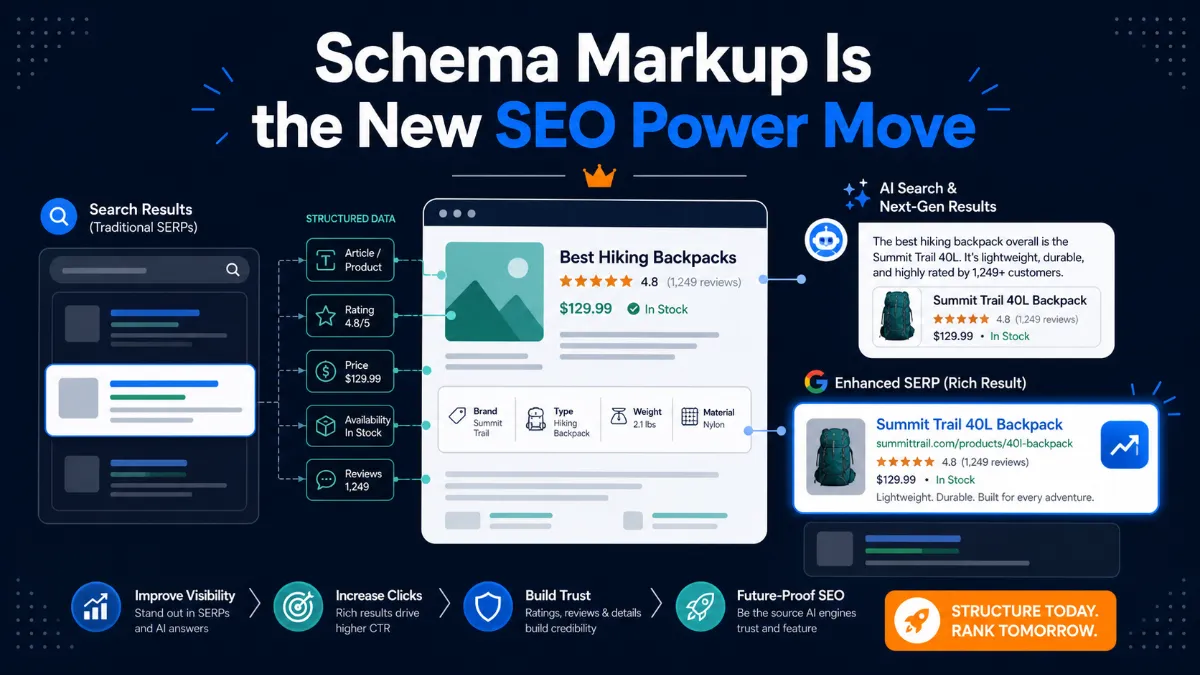
If you look at most modern SERPs, you’ll notice something: the plain blue link is no longer the main character. You see star ratings, FAQs, product details, breadcrumbs, sitelinks, images, event tags, and more. That extra real estate doesn’t show up by accident. It’s heavily powered by structured data.
Schema markup implementation enables your content to qualify for those rich experiences. When done right, it can:
- Expand your visual footprint on the SERP
- Give searchers critical decision-making information before they click
- Dramatically increase click-through rates by pre-selling your relevance
Think of a service business that shows up with FAQs directly under its listing, or a B2B solution that displays pricing, features, or review data right in search. Schema markup makes that possible, and those enhancements are becoming the default expectation for competitive queries.
For high-intent searchers actively trying to choose a vendor, rich results are not just “nice to have.” They’re often the deciding factor in who gets the click and who doesn’t.
The AI search revolution and why schema is central
Traditional search is no longer the only game in town. AI-powered search experiences, AI overviews, and conversational assistants are rewriting how people discover and evaluate solutions. In these systems, context and structure are everything.
AI systems ingest vast amounts of content and then synthesize answers. To do that responsibly, they lean heavily on content they can clearly interpret, classify, and trust. Schema implementation gives them the structured clues they need: what a page is about, what organization stands behind it, what products or services are being described, and how everything fits together.
Instead of your site being just “another URL” in the background training data, schema markup helps it become a clearly defined entity with attributes that can be cited and surfaced. That means more opportunities to:
- Be referenced in AI-generated answers
- Get pulled into knowledge panels and overview modules
- Serve as a primary source instead of a supporting detail
Proxy Marketing builds schema strategies with AI search in mind, not just classic SERPs. We treat schema markup as a way to future-proof visibility, so your content remains findable no matter how the interface of search evolves.
Turning content into revenue, not just rankings
One of the biggest mindset shifts we push with clients is this: SEO is not about traffic; it’s about qualified traffic that converts. Schema plays directly into that.
When schema markup supports your content, you’re not just improving visibility—you’re actively pre-qualifying visitors. Rich snippets and structured signals set expectations before the click. By the time a user lands on your page, they already know they’re in the right place, which shortens the path from visit to lead, booking, or purchase.
For high-intent users searching for very specific solutions—enterprise software, specialized services, complex B2B offerings—schema helps your content speak their language and align to their questions. That’s where rankings turn into real pipeline.
Why most sites are still under-using schema
Despite all of this, most websites either skip schema entirely or only implement the bare minimum. That leaves a huge competitive gap. On one side, you have brands whose sites are essentially a wall of unstructured HTML. On the other, you have sites where schema markup implementation has been strategically deployed to reinforce every key page type.
The difference in outcomes is stark:
- Better eligibility for rich results
- Stronger topical and entity signals
- More consistent alignment with high-value queries
- Increased trust from search engines and AI systems
When Proxy Marketing audits a site, we almost always find opportunities where schema markup can clarify content, tighten topical focus, and support a stronger commercial narrative. It’s one of the rare levers where gains compound across visibility, click-through rate, and conversion quality.
Strategic schema for serious buyers
High-intent searchers behave differently. They’re not casually browsing; they’re comparing providers, checking proof, and evaluating risk. Schema supports that journey.
When schema is planned around your actual buyer’s journey, it helps you:
- Reinforce expertise and authority for problem-aware queries
- Highlight solutions and outcomes for consideration-stage searches
- Surface trust signals and specifics for bottom-of-funnel queries
You can think of schema as the connective tissue that ties your content, brand, and offers together into a coherent story search engines can retell to the right people at the right time. Schema markup implementation doesn’t replace strong content—it amplifies it.
For businesses with longer sales cycles or high-ticket offers, that amplification matters. Every additional touchpoint where your structured information appears, whether in search or AI answers, nudges prospects a bit closer to choosing you.
Technical SEO, but with a narrative
There’s a perception that schema lives purely in the technical SEO bucket, somewhere between XML sitemaps and canonical tags. In practice, we treat it differently. At Proxy Marketing, schema markup is both a technical and narrative discipline.
Technically, it’s code. Strategically, it’s a way of telling search engines:
- “Here’s who we are.”
- “Here’s what we do.”
- “Here’s who we serve.”
- “Here’s where we should show up.”
That narrative has to map to your positioning and your revenue goals. Schema markup that isn’t grounded in real business outcomes might earn a few pretty search enhancements but won’t move the metrics that matter.
So when we design schema, we’re always asking: How does this support lead volume? How does it improve sales conversations? How does it help AI systems understand why this brand is the right answer for a high-intent query?
The compounding effect over your SEO timeline
SEO wins rarely show up overnight. Momentum builds in stages—crawlability, indexation, early rankings, brand visibility, and then serious lead flow. Schema plays a role in each phase.
Early on, schema implementation helps search engines quickly interpret new pages and understand how they fit into your overall site structure. As your authority grows, that structured clarity makes it easier to expand into new semantic neighborhoods—adjacent topics, service lines, and verticals.
Over time, this becomes a compounding asset:
- Your structured data history reinforces your topical authority
- Your rich results build brand familiarity on crowded SERPs
- Your presence in AI answers normalizes your brand as the safe choice
Schema markup implementation isn’t a one-off task; it’s a strategic layer that matures along with the rest of your SEO program.
Risk, compliance, and earning search engine trust
Search engines and AI platforms are under pressure to reduce misinformation and low-quality results. That means trust signals matter more than ever. Schema contributes to that trust—not by gaming the system, but by clearly aligning your claims with your visible on-page content.
When schema markup accurately reflects what’s on the page, you give search engines consistent, machine-readable proof of your reliability. Misaligned or spammy structured data, on the other hand, can cause issues, reduce eligibility for rich results, or trigger manual reviews.
Proxy Marketing treats schema implementation as part of your broader compliance posture: truthful, consistent, and clearly documented. That’s the approach that stands up over time, especially as AI systems get stricter about which sources they trust enough to surface.
Why DIY schema markup often falls short
There are plenty of generators, plugins, and quick tutorials out there promising instant schema benefits. Some of them are useful. But the gap between “there is schema on this page” and “schema markup implementation is driving measurable business outcomes” is wide.
Common DIY issues we see:
- Incomplete or generic markup that doesn’t match business goals
- Conflicting or duplicated schemas across templates
- Outdated or deprecated properties that send mixed signals
- Over- or under-marking content, confusing search engines instead of helping them
Schema markup implementation is most effective when it’s architected, not sprinkled. It needs to align with your information architecture, your content strategy, and your commercial focus. That level of alignment is where expert SEO services really pay off.
How Proxy Marketing approaches schema as a service
Because schema touches both technical and strategic layers, our approach is collaborative by design. We don’t just drop markup on a few pages and call it done. We work from your business model backward.
Our schema-centric process typically includes:
- Clarifying your primary revenue drivers and target personas
- Mapping key content types to their ideal schema classes
- Auditing current markup and identifying gaps or conflicts
- Prioritizing high-intent pages and critical journeys first
- Iterating based on performance data and evolving search features
Schema markup implementation becomes an ongoing tuning process, not a checkbox. We continually look for new opportunities where structured data can answer search engine questions more precisely—and where that precision supports your pipeline.
Schema and the future of “searchless” discovery
We’re moving into a world where people don’t always “search” in the traditional sense. They ask their phone, their car, their smart speaker, or an AI assistant for recommendations. They may never see a SERP, but they still get an answer.
In that world, structured data is oxygen. AI systems need clear, machine-readable representations of businesses, services, and content in order to recommend them confidently. Schema markup gives your brand a seat at that invisible table.
Instead of saying, “We hope people find us when they browse Google,” you’re positioning your site so that whichever AI is mediating the decision can understand exactly what you offer and who you serve. That’s a very different, and much more future-ready, posture.
Why now is the moment to act
The gap between brands that are investing in schema and those that are ignoring it is widening. Early adopters have already secured richer results, stronger entity recognition, and deeper integration into AI answers. Late adopters will find it harder to catch up as those signals compound.
If your business is already investing in content, technical SEO, and analytics, schema markup implementation is one of the highest-leverage additions you can make. It strengthens everything else you’re doing, clarifies your value to machines and humans alike, and helps capture more of the high-intent demand you’re working so hard to generate.
At Proxy Marketing, we see schema as part of a bigger story: turning search into an always-on growth engine, not a vanity metric. Schema markup implementation isn’t the only chapter in that story—but without it, the plot doesn’t quite hold together.